The rapid rise of generative AI is changing how people handle everyday tasks. From drafting emails and planning trips to answering questions about online purchases, these tools can respond to a text prompt. However, AI may invent information about attractions, misunderstand return policies or produce biased content. Systematic testing helps users and developers assess the quality and safety of these responses.
ISO/IEC 42119-8 aims to establish methods for assessing these text systems and improve the reproducibility and comparability of testing results. As of 13 October 2026, ISO lists it as ISO/IEC AWI TS 42119-8, an approved work item for a Technical Specification under development. It has not been published.
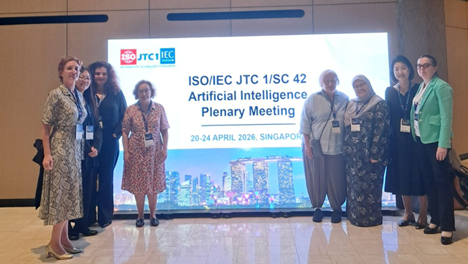
Its title is Artificial intelligence — Testing of AI — Part 8: Quality assessment of prompt-based text-to-text systems that utilize generative AI. The scope includes applications that generate text in response to text prompts, such as chatbots and enterprise question-answering systems. In April 2026, Singapore's Infocomm Media Development Authority (IMDA) and Enterprise Singapore (EnterpriseSG) publicly promoted the proposal for discussion at the 17th ISO/IEC JTC 1/SC 42 plenary meeting.
The proposed methods include benchmarking and red teaming. Benchmarking evaluates performance using defined datasets and scoring methods; red teaming probes weaknesses through adversarial prompts and related techniques. Public information also covers result analysis, interpretation and documentation, drawing on existing standards work such as ISO/IEC 42119-7. Hallucinations, bias and harmful content are practical evaluation topics; specific requirements will depend on the eventual published document.
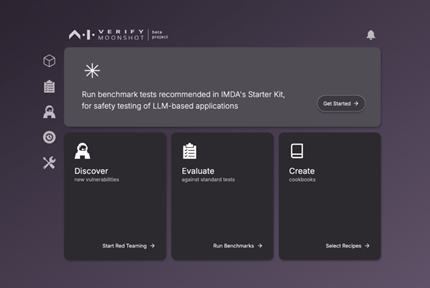
AI Verify Foundation's open-source Project Moonshot offers benchmarking and red teaming capabilities as a practical reference for building evaluation workflows. AIEC's existing Moonshot comparison presentation also highlights the need to consider question types and dataset settings when interpreting results. Using the toolkit does not establish conformity with ISO/IEC 42119-8.
Organisations can begin by defining evaluation goals for their use cases, preparing test data in the intended language, recording model versions, prompts and scoring methods, and retesting after system updates. These practices help track quality changes and provide inspectable evidence for procurement and risk management.