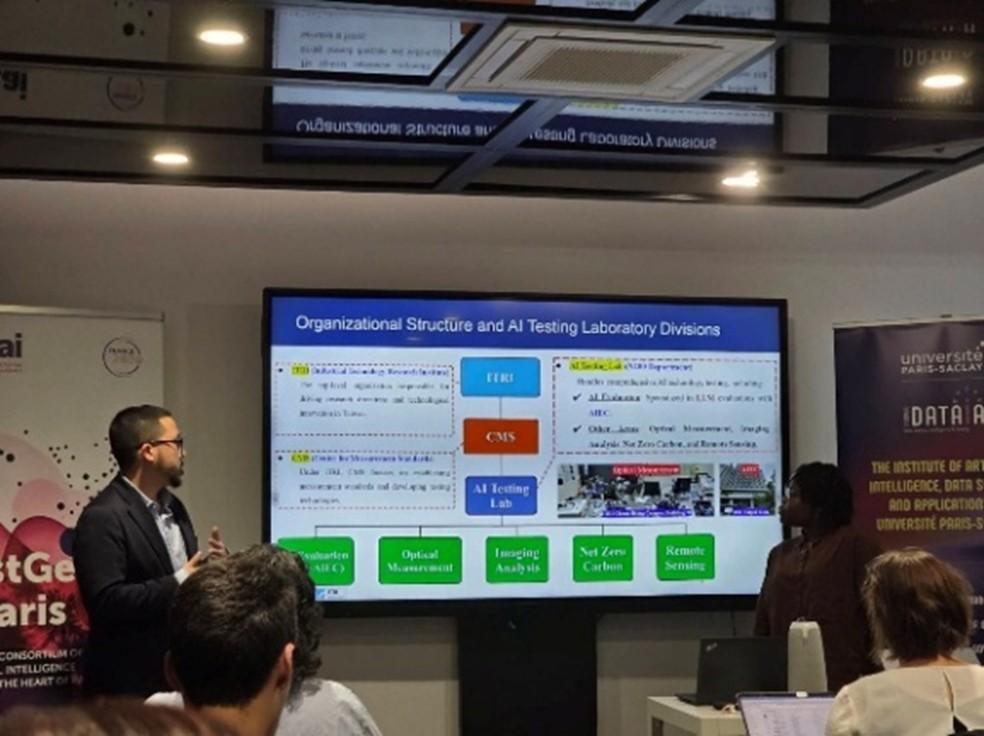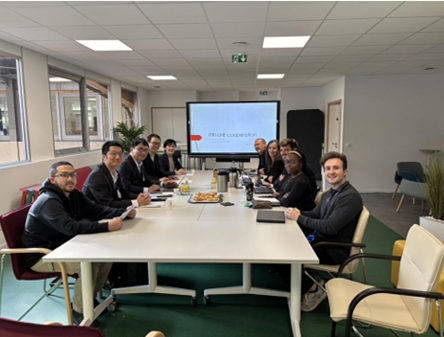
In October 2025, the AI Products and Systems Evaluation Center(AIEC) dispatched a delegation to the Laboratoire national de métrologie et d'essais(LNE) and the Bureau Français de Taipei(BFT) in France. By leveraging France's practical experience in trustworthy AI evaluation, this visit aimed to align Taiwan's AI evaluation capabilities with international practices. The mission also coincided with an AI workshop organized by BFT in Paris, where AIEC publicly presented the results of cross-cultural large language model(LLM) test bank evaluations, further enhancing AIEC's visibility in the global professional community.
In terms of technical collaboration, AIEC and LNE held intensive working meetings at LNE's Trappes laboratory, completing the translation, verification, and cultural adaptation of a trilingual(Chinese–English–French) item bank. The two sides also conducted preliminary analyses of item difficulty, cultural sensitivity, and model response behaviors. The design of the item bank drew on international standards such as ISO and the NIST AI Risk Management Framework(AI RMF), as well as open-source question repositories, in order to ensure fairness, reproducibility, and cross-country comparability of evaluation results. These outcomes will serve as an important foundation for developing standardized LLM testing services in Taiwan.
The delegation also visited LNE's Paris headquarters and the LEIA laboratory to gain an understanding of LNE's evolution since 1901—from metrology and quality inspection to AI and robotics evaluation. On-site observations covered LNE's practices in data governance, model validation, risk management, and laboratory operations. These experiences will assist ITRI in planning AI testing laboratory environments, measurement procedures, and documentation requirements, gradually aligning with the European Union's compliance expectations for high-risk AI systems.
Looking ahead, AIEC and LNE will continue to expand the cross-cultural item bank and multilingual datasets, jointly develop trustworthy AI evaluation metrics, baseline procedures, and prototype tools, and explore co-authoring technical documents and international conference papers. The cooperation mechanisms established through this visit are expected to help domestic companies obtain credible third-party testing support when responding to regulations such as the EU AI Act, and to strengthen Taiwan's voice in global AI evaluation and standards development. Overall, this mission to France has achieved its intended objectives and laid a solid practical and network foundation for expanding future cooperation.